Showing posts with label stem. Show all posts

Monday, March 9, 2015

USNA STEM Hosts Girls Only Workshop

By MC3 Nathan Wilkes

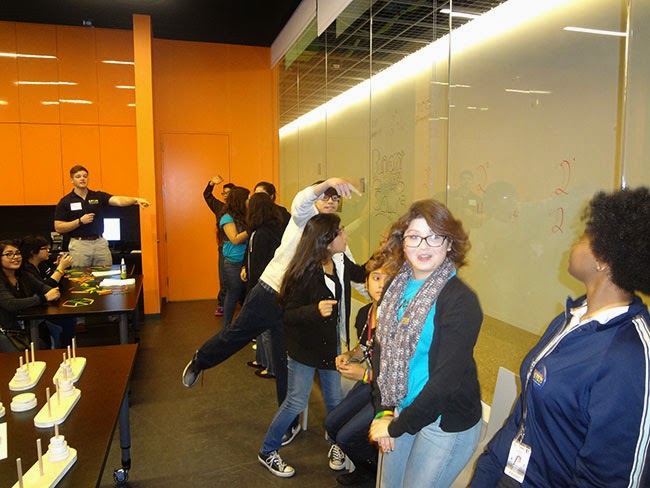
The U.S. Naval Academy’s (USNA) Science Technology Engineering and Mathematics (STEM) program hosted a “Girls Only STEM Workshop” for middle school-age girls Saturday, Mar. 7, in Rickover and Michaelson Hall.

More than 300 girls from around the region participated in the career forum facilitated by female role models from the Academy.


 “Today we are hosting middle school girls who are interested in STEM majors and exposing them to some of the math and science topics that they could possibly study in high school, college, and later in their careers,” said Midshipman 3rd Class Allison Latham. “This program is a great way to introduce young girls to different STEM subjects in fun ways and teach them that if they study hard and work hard, it will pay off.”

The day-long workshop included hands-on activities in robotics, bioterrorism, aerospace, biometrics, physics and more.

“We really want the students to have exposure to technical fields and STEM topics that they might not be covering in their normal classes,” said Angela Moran, USNA professor of mechanical engineering and STEM Outreach Director. “One of the main goals of the event today is to set these girls up with the tools that they will need to succeed in STEM topics in the future.”


Forty USNA midshipmen and 15 female faculty members helped facilitate the event. Their experience and knowledge helped the girls to learn the topics easily and identify role models in the STEM community.

“We are having a lot of fun and are learning a lot about how STEM can help you with a lot of things,” said Annabelle Sehefer,  a 6th grader from Virginia. “In one of my classes today I learned how to protect my house during a hurricane with the wave machine, which was really fun.

The culminating event of the workshop was an engineering mini-design challenge. Students formed groups to put their creativity to the test to design and develop their own amphibious and aviation vehicles. Once the vehicle is created, each group must use teamwork to overcome certain design obstacles.


“I think the design challenge is a fun way to put together everything that we learned today and it really opens your mind to some things that you can do when you’re older,” said Haley Cordova, a 6th grader from Virginia. “The best part about STEM is that they make the classes very interactive and fun. It makes it easier and more enjoyable to learn.”

“Sometimes a little bit of hard work and tough choices can make the difference in long-term fun and fulfillment with what these girls choose to do with their lives, said Moran. “It sounds pretty serious, but today is the first step for helping these girls to step up their futures and we do it in a creative and fun way.”

This event is sponsored by the Office of Naval Research, the Naval Academy Foundation, the Northrop Grumman Foundation and The Bauer Foundations.

Monday, February 23, 2015

USNA Hosts STEM Educator Training

By MC3 Nathan Wilkes

The U.S. Naval Academy's (USNA) Science Technology Engineering and Mathematics (STEM) program hosted a STEM Educator Training Workshop for K-12 teachers Saturday, Feb. 21, in Rickover and Michelson Hall.

More than 70 STEM educators participated in the day-long event. USNA Midshipmen and faculty provided a hands-on and project-based learning experience in topics such as design, bioterrorism, physics and mechanics, applied math, alternative energy, computer programming and cryptography, and engineering.


"Today we have formal educators of elementary, middle, and high schools from as far away as Chicago and Memphis, as well as teachers from Maryland, and they are rotating through project-based learning modules in STEM topics," said Angela Moran, USNA professor of mechanical engineering and STEM Outreach director. "The educators rotate through three of five offered modules this morning and in the afternoon they will learn about engineering design and focus on putting that into practice in their classrooms."

One of the main goals of the STEM Educator Training Workshop is to increase instructor excitement for learning STEM topics so that they may share what they have learned with their students.

“The more enthusiasm that they can apply in the classroom, the more excited the students will be about math, science, and technology,” said Lt. Cdr. Tim Shivok, USNA physics instructor. “The United States needs more teachers that teach math and science so that we can develop people that will study these fields in the future.”


The day-long workshop offered K-12 teachers an opportunity to engage more fully in their educational fields by exploring and testing ideas in a creative and hands-on environment.

“It’s a great experience because the facilitators can make the workshop apply to each of the different grade levels and the learning topics are very diverse,” said Helen Shields, biology teacher at Crofton Meadows Elementary. “I think that it’s great that this free opportunity is offered to educators and that it’s able to give us a different perspective of STEM topics.”

The culminating event of the workshop was an engineering design competition. During the competition, the teachers formed groups and were tasked with designing a STEM project for their classrooms that incorporated the educational tools and lessons that they learned from the modules earlier in the day.


“This experience has been very eye-opening for me because I’m seeing many aspects of different STEM programs that I can take back to my own students,” said Ultra Vaughn, freshman biology instructor from Chicago, IL. “The modules were very fun and I think the kids would really get into some of the ideas that I have seen today.”

"We tell the teachers that the most infectious way of teaching is to learn right along with their students," said Moran. "When they are excited about what they are doing, the kids can see the difference and pick up on it."

Thursday, February 19, 2015

Mids Teach STEM Workshops to Dallas Students

By Rylan Tuohy

“Our goal isn’t to convince students to come to the Naval Academy, our goal is to expose students to the awesomeness of STEM,” said MIDN 2/C Zachary Dannelly to a group of middle school students at the Perot Museum of Nature and Science in Dallas, Texas, earlier this month.


Dannelly and seven other midshipmen - MIDN 2/C Rachel Busiek, Max Goldwasser, Peter Guo, Megan Hough, Hunter Lampp, Luke Riewestahl, and Rylan Tuohy - traveled to Dallas to work with 125 students from Greiner Middle School and Balch Springs Middle School in areas of cyber, cryptography, fluids, and hydraulics.

The midshipmen represented the U.S. Naval Academy STEM (Science, Technology, Engineering, and Mathematics) Center.

Naval Academy graduate John Young (USNA '78), president and CEO of a Dallas-based energy company also spoke to the participating students. Emphasizing the importance of STEM, Young talked about his time at the Academy, his military career, and how his studies in STEM topics prepared him for the future.


The Perot Museum of Nature and Science opened their state-of-the-art facilities for the eight midshipmen to lead classrooms of hands-on modules and interactive lessons in order to excite kids about STEM. In the cyber and cryptography lab, Guo and Goldwasser played interactive games about binary numbers. In the fluids and hydraulics lab, Busiek and Hough led buoyancy modules with students, attempting to solve the question "Why do steel ships float?"

The USNA STEM Center is focused on addressing an urgent national need for more young people to pursue careers in STEM fields. USNA faculty, like Professors Rachel Hetlyn and Jennifer Da Rosa, and midshipmen provide STEM outreach to local and national communities in an attempt to engage and influence students and teachers. Through events like these, midshipmen learn outside the classroom.

“The challenge is how to teach complex ideas on a basic level,” said Dannelly. “By overcoming that challenge and working with the students, we learn too.”

Sunday, January 11, 2015

USNA's Summer STEM Program Accepting Applications

By LT Teng K. Ooi and CAPT Linda J. Beltra

Applications for the 2015 Naval Academy Science, Technology, Engineering, and Mathematics (STEM) Summer Program are open. The application can be accessed at www.usna.edu/admissions/STEM.

Session dates include June 1-6 for rising 9th graders; June 8-13 for rising 10th graders; and June 15-19 for rising 11th graders.


This annual summer program is designed to expose young people to STEM concepts and technologies and to encourage 9th-11th graders to pursue a course of study in engineering and technology throughout high school, college and beyond.

The aim is to integrate STEM-focused concepts across the curriculum and pave the way for students to succeed academically in mathematics and science and help put them on a path towards successful STEM careers. An effective and practical way to stimulate student interest in STEM is to show how mathematics and science are applied to create exciting technologies.

The 2015 STEM program will showcase the latest in technological advances in a wide variety of science and engineering topics to include energy and light, infrastructure, transportation, cybersecurity, environmental challenges, flight and fluids, automation, simulation and modeling, biometrics and robotics.


Students will participate in project-based modules using a hands-on, real-world approach to solving design and analysis problems at the Naval Academy’s world-class laboratory facilities. This unique learning environment promotes engineering “habits of mind” such as critical thinking, optimization, innovation, creativity, and team work. It exposes students to a problem-based environment outside the traditional classroom.

The 2015 Summer STEM Program is a great start to a student’s career in science and engineering.

Friday, October 24, 2014

Women of Innovation at USNA

By Midshipman 2nd Class Rachel Busiek

This past weekend USNA hosted a STEM event unlike any other! Roughly 300, 8th-grade girls from the surrounding communities traveled to the Academy for a day of education and design. 


The morning commenced with the girls participating in opening exercises to learn basic scientific principles and interact with each other as many of the girls did not know anyone else at the event.

Following introductions, the young ladies attended two of the numerous modules instructed by Naval Academy professors. Module topics covered a wide range of topics: aquaculture, biometrics, bioterrorism, Calcbots, laparoscopic surgery, rockets, fun with physics, NXT bots, and a pattern recognition module called "Lost at Sea."

Although the event was predominantly targeted at the young girls, they were not the only people attending classes and having fun that morning. While the girls learned about STEM topics, their parents were able to sit in on a variety of lectures that were aimed at optimal development for their children.


The parents' schedule included briefs about "Raising the Whole Girl," nutrition, the benefits of STEM education, college costs and benefits, as well as a leadership panel that was run by the midshipmen who were the leads and helped develop Girls STEM Day: 1/C Jennifer Pendleton, 2/C Rachel Busiek, and 2/C Montana Geimer.

Following a brief lunch break, the parents were released for the day to explore USNA and the surrounding areas; however, the girls applied the knowledge they had learned earlier in the morning during a design competition. The design for this year’s event was focused on "Women of Innovation" with a particular emphasis on leadership.

The girls were divided into teams of three and assigned a task to develop either an amphibious craft that can transit from land to sea while protecting a payload, or an aviation glider that can transit from a launch platform to the ground while protecting a payload. 


Overall, the feedback from the design portion and the day was great! Many young girls bragged about new career goals they had developed as a result of the day’s events and career and educational opportunities they were excited about that they previously did not even know existed.

This type of feedback and response is precisely why the Girl’s STEM Day is hosted each year and continues to be such a success!

Friday, July 18, 2014

Naval Academy Workshops Help Enhance Education in U.S., International Schools

Post by MC2 Jonathan Correa, USNA Public Affairs

The U.S. Naval Academy recently hosted workshops for more than 115 educators from across the U.S. and international schools to help enhance their curricula in science, technology, engineering, math and languages.
In the month of July alone, the academy offered three separate programs for educators: the Set Sail program for STEM fields attended by 90 teachers, the Maury Project for oceanography and meteorology attended by 24 teachers, and in collaboration with Anne Arundel Community College the StarTalk program for education in Arabic attended by 8 teachers and 48 students.
Teachers attending the Set Sail program at USNA
Photo courtesy of the USNA STEM Office 
 “The number of experiences and training we offer to educators signifies USNA’s willingness to be a participant in the national effort to bolster important areas in education through sharing our excellent resources and talented faculty and staff,” said Naval Academy Vice Academic Dean Boyd Waite.
These workshops each equip teachers with training and teaching materials that can be used in their classrooms. Educators participate in lectures and tutorials, research cruises and field trips, and hands-on exercises in the Naval Academy’s world-class laboratories and classrooms.
As many schools have become more lecture-based, the Set Sail program is designed to encourage educators to return to more hands-on teaching methods.
“We teach the educators the same way we teach our midshipmen,” said Naval Academy chemistry Professor Sarah Durkin of the USNA STEM office. “We teach them laboratory-based teaching techniques.” 
This workshop gives teachers the opportunity to discover, explore and test ideas, and, most importantly, learn how science and technology impact real-world research and challenges. The teachers participate in projects using underwater robotics, forensic chemistry including the study of corrosion, and projects using the hydro lab, and bioterrorism labs, among others.
Teachers attending the Set Sail program at USNA
Photo courtesy of the USNA STEM Office 
One of Set Sail’s design challenges was comprised of building a maze with limited resources including wood blocks and glue. Teachers used engineering design techniques and principles of levers to get marbles from one end of the maze to the finish end in order to complete the task. Teachers also participated in a bioterrorism lab simulating a smallpox breakout. Each teacher was given a container replicating smallpox but only one container is actually “affected” with the virus. Each teacher then had to share their sample with three other teachers, which demonstrated the spread of the disease.

The Maury program also focuses on experiences that give educators the opportunity to discover new ways in which science and technology impact real-world research and challenges.
This summer’s 21st annual Maury Project focuses on the physical foundations of oceanography and includes intensive training sessions comprised of lectures, tutorials, seminars, research cruises, hands-on laboratory exercises, and field trips. Seven laboratories located in the USNA Oceanography Department and a fully-equipped 108-foot oceanographic research vessel providing teachers with a multitude of hands-on training opportunities.
“The Maury Project promotes minority participation in science through teacher enhancement,” said Dr. David Smith, retired professor and former chairman of the Naval Academy oceanography department. “The goal is to train as many teachers as possible who are members of groups underrepresented in the sciences and/or teach significant numbers of pre-college students from underrepresented groups.”
Smith co-directed the Maury Project with Dr. Jim Brey, education director of the American Meteorological Society.
Teachers attending the Set Sail program at USNA
Photo courtesy of the USNA STEM Office 
In addition to STEM related areas, the Naval Academy  also provides educators and students foreign language and cultural education.
The StarTalk program is a government initiative to increase the number of Americans learning critical need languages and teachers start with a ten-day online course followed by two weeks of face-to-face training and planning at the Naval Academy. Directly after this training, high school and college students arrive to the Naval Academy for a four-week novice and novice/mid-level Arabic course. This gives the teachers a chance to use their new teaching skills and enables them to improve their own teaching techniques.
The program at the Naval Academy focuses on Arabic and offers students and educators an elaborate cultural education through developing language and writing skills, as well as a deep cultural understanding through music, arts, and sports participation.
 “Some of the topics we offer at the Naval Academy are American Council on the Teaching of Foreign Languages (ACTFL) standards, differentiated teaching, student-centered learning, brain-based learning, comprehensible input, relevance and student motivation, and small group learning,” said Clarissa Burt, Naval Academy professor of Arabic language, literature and culture.
These programs provide educators’ with tools they can use in their own classrooms and pass on to their peers to help further enhance the curricula offered in their home school districts.